Since 2021, Emulate and Skellefteå Kraft have been building something the energy industry had never seen at scale – a system that connects thousands of residential DERs, turns them into a virtual battery, and monetizes that flexibility in real time. We sat down with Jonny Blomberg, Chief Product Officer at Emulate, to trace the full journey: the early bets, the hard lessons, the milestones, and what comes next.
The People Behind the Partnership
Let’s start with the basics. Who are you and what do you do at Emulate?
I’m Jonny, Chief Product Officer at Emulate. In practice, that means I’m responsible for making sure we’re building the right product for the right market – owning the roadmap, prioritization, and product direction. I also oversee customer onboarding after a deal is signed and technical product support. My role spans from long-term strategy all the way through to day-to-day operations.
How It Started
What made Skellefteå Kraft the right partner to build with from day one?
Skellefteå Kraft is a municipality-owned power company founded in 1906, headquartered in Skellefteå, Sweden. What began as a local hydroelectric operation to power the region’s mining industry has since grown into one of Sweden’s top five renewable electricity producers – supplying electricity nationwide from hydropower and wind, while also offering district heating, broadband, and EV charging solutions. They have also backed innovative energy companies as investors, which tells you something about how they think.
That mindset is exactly what made them the right fit. They have the nationwide presence and scale you need in a founding partner – but size alone isn’t enough. What set them apart was their attitude: genuinely forward-leaning, willing to move, and open to doing things differently. That combination is rare in an industry that doesn’t always reward bold bets.
The relationship also worked on two levels simultaneously: they became a customer and an investor. That dual commitment meant they had real skin in the game from the start – not just as a partner hoping things would work out, but as one with every reason to make sure they did.
What was Emulate trying to prove at that point, and what did Skellefteå Kraft bring that you couldn’t have done without them?
We needed to prove two things. First, that there was a real market need – that energy retailers were actually looking for a solution like ours. Second, that it was technically feasible to deliver this at scale.
Skellefteå Kraft gave us both the access and the feedback to prove it. Without them, we couldn’t have gone live in any meaningful way. They were one of our very first real customers, and we actually launched with them nationwide. That’s not something you can replicate in a lab environment. On top of that, they gave us extremely valuable insight in the early days to make sure we were building something that genuinely met the needs of an energy retailer. That kind of grounded, real-world feedback is priceless when you’re finding your footing.
What did the relationship feel like in those early days – cautious, ambitious, experimental?
“It felt, and still feels, like a true partnership rather than a supplier-customer dynamic. In a fast-moving industry like this one, you can’t afford a transactional relationship. You need quick feedback loops, transparency, and a shared stake in the outcome. We both succeed, or we both don’t.”
That spirit was there from the beginning, and it hasn’t changed.
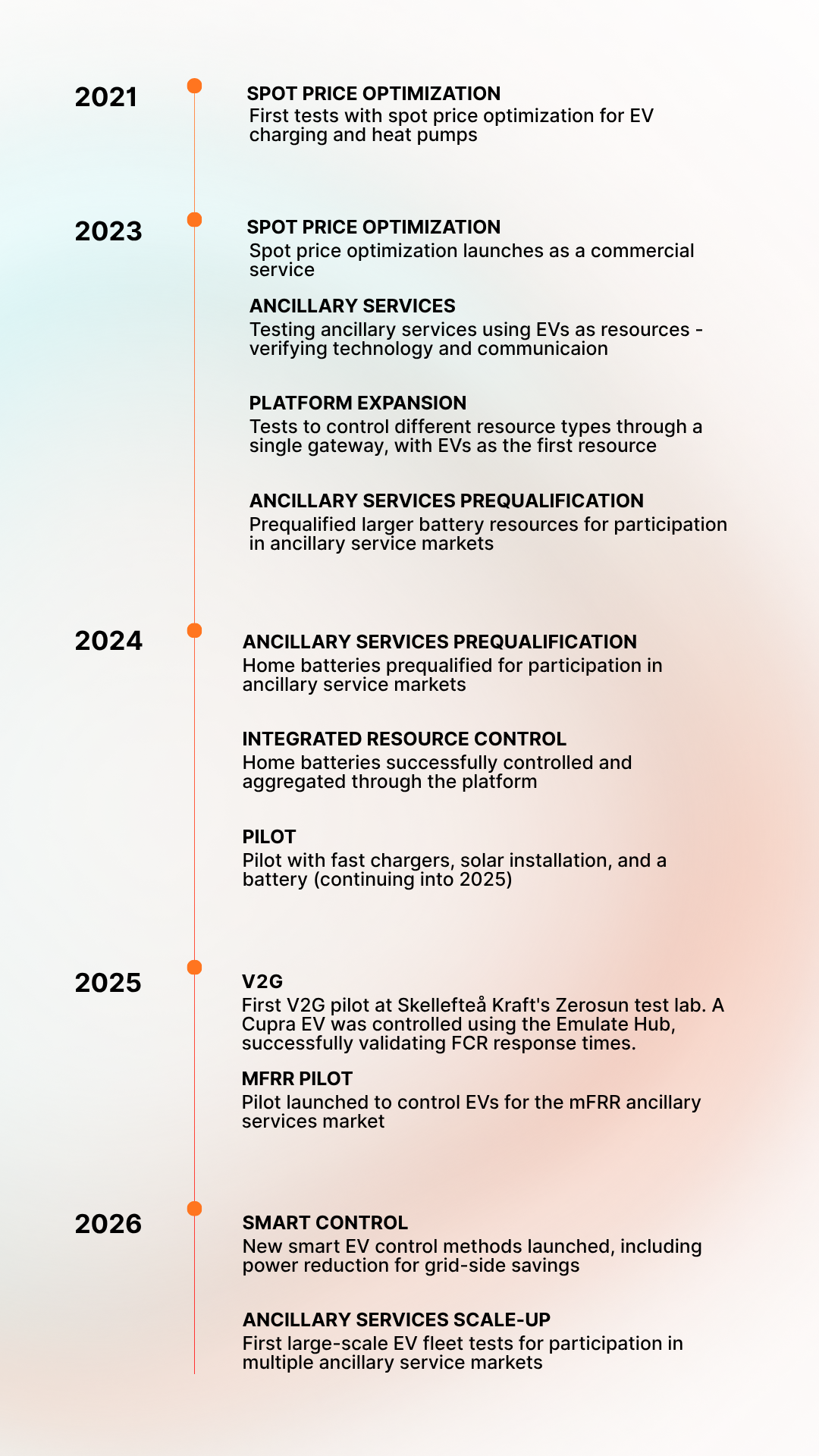
The Journey: 2021-2026
The Big Leap
Looking across that whole arc, which single step felt like the biggest leap?
There are two moments that stand out. The first is simply going live for the first time back in 2021 – launching spot price optimization for EVs and other residential DERs out into the real market. That was the proof of concept becoming reality. The first step is always the hardest and the most important.
But the next big step is what we’re doing right now, and it’s the one I’m most excited about. We’re taking thousands of DERs and aggregating them into one virtual battery. Then we use that collective flexibility and monetize it, earning revenue from it on the energy markets. This has always been the vision. It maps directly to our two core product modules: Orchestrate, which handles the optimization and personalization of individual assets, and Monetize, which turns that aggregated flexibility into real revenue on the energy markets. We’re now realizing that the second module, together with Skellefteå Kraft.
The Honest Truth About V2G
Vehicle-to-grid is a milestone many talk about, but few have actually delivered. Where does V2G genuinely stand today?
We’ve run pilots with Skellefteå Kraft on V2G, and we’ve been able to demonstrate that it’s technically possible on a small scale. One important milestone came in spring 2025, when we completed our first V2G pilot at Skellefteå Kraft’s Zerosun test lab in Skellefteå. Using Emulate’s hub, we controlled a Cupra EV and successfully tested the response times required for FCR (Frequency Containment Reserve).
That pilot confirmed the technical feasibility of the solution, while also highlighting what still needs to mature before large-scale deployment.
The challenges aren’t only technical, though those exist too. There are commercial hurdles and regulatory gaps that the industry hasn’t resolved. The standards simply don’t exist yet. We’re actively engaged with industry bodies and grid operators to help shape what those standards look like, because the companies doing the work at the frontier are the ones best placed to inform them.
So we’ve tested it, we’ve learned from it, and we’re continuing to push it forward. The direction is clear, V2G will eventually become a mainstream flexibility resource. The work we’re doing now on mFRR prequalification is laying exactly the kind of foundation that will make that possible. But we’re not at the point where we can say: let’s roll this out everywhere. We’re building toward that.
Innovation, Pivots, and Lessons Learned
Were there moments during these five years where things didn’t go as planned? What did you learn?
Many. The journey has involved system disruptions we had to respond to quickly, pilot projects where our initial hypotheses proved wrong, and situations where we had to pivot significantly mid-course.
“Looking back, those so-called failures have always led to new learnings and pivots that turned out to be breakthrough innovations. Working with unknowns – taking one step in the right direction, learning, and adjusting – that’s been the defining pattern of everything we’ve done together.”
Nothing about building in this space is trivial. The aggregation work we’re doing now with the Monetize module is genuinely technically complex. The broader industry is still immature, and in many ways, we’re building the road as we drive on it.
What Five Years Have Proven
What results have you seen – for retailers and their customers?
We’ve connected thousands of devices, corresponding to thousands of active customers using the service on a regular basis. We’ve saved millions of Swedish kronor in energy costs for end users, and we’ve managed charging across several megawatts of energy for the retailer.
But beyond the energy figures, there’s a customer loyalty dimension that matters just as much. We’ve seen a measurable reduction in customer churn. Customers are more satisfied, more engaged, and they stay longer. In the end, that’s what every energy retailer is really after – services that make their customers want to stay.
What has this partnership actually proven about the technology, the market, and what’s possible with electric vehicles on the grid?
It has proven product-market fit. We have thousands of Skellefteå Kraft customers actively using our optimization services to reduce their energy costs. That’s not a hypothesis anymore, that’s demonstrated demand at scale.
It has also proven that an established, large energy retailer can develop and successfully bring these kinds of services to market. And perhaps most importantly, it has proven that the value of flexibility in the energy system is real. That’s the foundation of everything Emulate does, the belief that a flexible energy system isn’t just possible, it’s necessary. We’ve now shown that in practice. Not in a pilot, not on paper. In the real market, at scale.
What are you personally most proud of from this collaboration?
Two things. First, that we’ve actually managed to aggregate DERs into a virtual battery and begin monetizing that flexibility; that’s entering a genuinely new phase, and it’s something I’m proud we’ve made real together. Second, Skellefteå Kraft has been our fastest-growing customer over the last twelve months. We’ve almost doubled their connected fleet size in the past year. A lot of hard work went into that, most of it from them.
Skellefteå Kraft’s Perspective
“The collaboration with Emulate has been incredibly valuable for us. They genuinely listen to our ideas and take both our feedback and market insights seriously. Together, we’ve been able to develop services that keep pace with the changing energy market while meeting the needs of our customers. The response from our customers has been very positive, and we’re excited to see how our upcoming features and services will be received by our customers.” – Anders Rindevall
The Closing Word
One last question: what does five years of building together with Skellefteå Kraft prove about the energy transition?
“What we once considered science fiction, connecting thousands of DERs, aggregating them into a virtual battery, monetizing that flexibility across energy markets, while simultaneously saving costs for the end user, at scale, is becoming the new normal. What is considered state-of-the-art today will simply be standard practice in five years. That’s not ambition. That’s where we’re headed.”
Emulate partners with energy retailers to orchestrate and monetize distributed energy resources. Skellefteå Kraft has been a customer and investor since the earliest days of the company.
Interested in what Emulate can do for your business? Get in touch →