Behind Sweden’s Tariff Pause: Why the Grid Investment Problem Isn’t Going Away

Sweden has moved forward with pausing the mandatory rollout of demand-based network tariffs set to take effect January 1, 2027. The decision is being watched closely across Europe. Sweden has long been considered a leading market for energy flexibility and smart grid policy. But pausing a tariff model does not remove the underlying cost of grid congestion and high peak demand.

As we highlighted in our previous article, “Demand Charges: A Wake-Up Call for Swedish Energy Providers”, the real issue isn’t the specific tariff model itself; it’s whether households and businesses have the tools to manage these costs efficiently, or simply pay them invisibly. Sweden’s pause underscores that these costs remain, regardless of how they are collected.

The scale of the problem

Europe’s grids are under pressure unlike anything seen before. According to the European Commission, Europe needs €584 billion in grid investments by 2030. European electricity consumption is expected to grow by around 60% by 2030. Already, 40% of Europe’s distribution grids are more than 40 years old. And BCG estimated grid upgrade costs at $5,800 per electric vehicle, if charging is not optimized.

When you buy an electric vehicle, the network operator delivering electricity to your home needs to invest $5,800 to handle the extra load if charging is not managed. And that is just the beginning. Your heat pump, rooftop solar panels, and battery storage (BESS) all add to the grid’s burden as well.

What many people miss

Pausing a specific tariff model does not remove the cost. It only changes how the cost is collected.

In practice, it will still be recovered through one of three broad channels: more cost-reflective tariffs such as demand charges or power-based fees; higher general network charges for everyone combined with flexibility incentives or flexibility procurement; or oversized grid expansion whose costs are socialized across electricity bills and taxes.

There is no alternative universe where the laws of physics disappear.

And Europe is not abandoning cost-reflective pricing. ACER, the EU Agency for the Cooperation of Energy Regulators, has been clear: network tariffs must be fair, cost-reflective, and send signals for more efficient use of the grid. The direction of travel across Europe is toward greater, not less, granular cost exposure. Sweden’s pause is a political delay, not a policy reversal.

So the real question is not whether a specific Swedish tariff model survives in its current form.

The real question is: how do we maximize value for consumers while reducing peak loads, increasing flexibility, and using the electricity grid more efficiently?

Emulate’s view

At Emulate, our view is straightforward. The winning architecture is not built around any single tariff model. It is built around the capability to optimize across the entire value stack, whatever form that stack takes.

Emulate already optimizes against custom tariffs, spot prices, demand charges, local flexibility markets, and ancillary service and energy markets. The platform supports both cloud APIs and local gateways in a hybrid configuration, and is already operating across markets with different tariff structures and regulatory frameworks. That real-world diversity is exactly what prepares us,  and our customers, for what comes next.

As 2026 and 2027 bring further regulatory movement across the Nordics and broader Europe, the ability to adapt optimization logic quickly will separate the platforms that future-proof their customers from those that simply react.

Regardless of how costs are exposed to consumers, we align optimization to their reality. That is what future-proofing actually means.

“You can pause a tariff. You cannot pause the cost of peak demand. The question is not whether the cost exists. The question is whether households get the tools to optimize around it,  or simply pay it in a less transparent way.”

Prefer to read in Swedish?

A Swedish-text version of this article can be found below the English version.


Bakom Sveriges tariffpaus: Varför problemet med nätinvesteringar inte försvinner

Sverige har länge betraktats som en ledande marknad för energiflexibilitet och smart elnätspolitik. Att pausa en effekttariffmodell tar inte bort den underliggande kostnaden för trängsel i nätet och höga effekttoppar, utan kostnaden förflyttar sig bara.

Som vi lyfte fram i vår tidigare artikel, ”Demand Charges: A Wake-Up Call for Swedish Energy Providers”, är det verkliga problemet inte själva tariffmodellen; det handlar om huruvida hushåll och företag har verktygen för att hantera dessa kostnader på ett effektivt sätt, eller bara betalar dem utan insyn. Sveriges paus understryker att dessa kostnader kvarstår, oavsett hur de tas ut.

Problemets omfattning

Europas elnät är under ett tryck som aldrig tidigare skådats. Enligt Europeiska kommissionen behöver Europa 584 miljarder euro i nätinvesteringar till 2030. EU:s elanvändning väntas öka med cirka 60% till 2030. Redan nu är 40% av Europas distributionsnät mer än 40 år gamla. Och BCG uppskattade nätuppgraderingskostnader till 5 800 dollar per elbil om laddningen inte optimeras.

När du köper en elbil behöver nätbolaget som levererar el till ditt hem investera 5 800 dollar för att hantera den extra belastningen  om laddningen inte styrs. Och det är bara början. Din värmepump, solceller och batterilager (BESS) påverkar också nätet.

Det är många som missar poängen

Att pausa en viss tariffmodell tar inte bort kostnaden. Det förändrar bara hur kostnaden tas ut.

I praktiken kommer den fortfarande att tas ut genom någon av tre breda kanaler: mer kostnadsreflekterande tariffer som effektavgifter; ökade nätavgifter för alla kombinerat med flexibilitetsersättningar eller upphandling av flexibilitet; eller överdimensionerad nätutbyggnad vars kostnader socialiseras via elräkningar och skatter.

Det finns inget alternativt universum där fysikens lagar försvinner.

Och Europa överger inte kostnadsreflektion. ACER, EU:s byrå för samarbete mellan energiregleringsmyndigheter, har varit tydliga: nättariffer ska vara rättvisa, kostnadsreflekterande och ge signaler för mer effektiv användning av elnätet. Riktningen i Europa går mot större, inte mindre, detaljerad kostnadsexponering. Sveriges paus är en politisk fördröjning, inte en politisk kursändring.

Så den verkliga frågan är inte om en specifik svensk tariffmodell överlever i sin nuvarande form.

Den verkliga frågan är: hur maximerar vi värdet för konsumenterna samtidigt som vi minskar effekttoppar, ökar flexibiliteten och använder elnätet mer effektivt?

Emulates syn

På Emulate är vår syn enkel. Den vinnande arkitekturen byggs inte kring en enda tariffmodell. Den byggs kring förmågan att optimera mot hela värdestacken, oavsett vilken form de tar.

Emulate optimerar redan mot anpassade tariffer, spotpriser, effektavgifter, lokala flexibilitetsmarknader samt stödtjänst- och energimarknader. Plattformen stödjer både moln-API:er och lokala gateways i en hybridlösning och är redan verksam på marknader med olika tariffstrukturer och regulatoriska ramverk. Den verkliga mångfalden är precis det som förbereder oss och våra kunder för det som kommer härnäst.

När 2026 och 2027 för med sig ytterligare regulatoriska förändringar i Norden och bredare Europa, kommer förmågan att snabbt anpassa optimeringslogiken att skilja de plattformar som framtidssäkrar sina kunder från dem som bara reagerar.

Oavsett hur kostnaderna exponeras för konsumenterna anpassar vi optimeringen efter deras verklighet. Det är vad framtidssäkring faktiskt innebär.

“Du kan pausa en tariff. Du kan inte pausa kostnaden för effekttoppar. Frågan är inte om kostnaden finns. Frågan är om hushållen får verktyg för att optimera kring den eller bara betalar den på ett mindre transparent sätt.”

Emulate Energy Partners with Hansen Technologies to Bring Residential Flexibility into the Heart of Utility Operations

The homes of today are becoming the power plants of tomorrow. We’re making sure utilities can actually trade them. 

We’re excited to announce our strategic SaaS partnership with Hansen Technologies (ASX: HSN),  one of the world’s leading software providers for the energy and utilities industry. 

Together, we’re turning the distributed energy devices already sitting inside millions of homes into structured, tradable flexibility assets, embedded directly within utilities’ commercial and trading systems.

Why This Matters Now

The energy transition isn’t waiting. EVs, heat pumps, batteries, and rooftop solar are scaling fast across residential portfolios. But for most utilities, this wave of behind-the-meter devices looks less like an opportunity and more like a headache, fragmented, unpredictable, and impossible to coordinate at scale. 

The problem isn’t the hardware. It’s the missing layer of intelligence that connects homes to markets. That’s exactly what this partnership solves.

What We’re Building Together

By combining Emulate’s AI-powered Home Energy Management System (HEMS) and production-proven Virtual Battery capabilities with Hansen’s Customer Information System (CIS), Energy Data Management (EDM), and trading ecosystem, utilities get a complete, end-to-end pathway from residential device to wholesale market. 

For utilities, this translates into four concrete capabilities:

  • Orchestrate behind-the-meter devices in a tariff-aware, market-integrated way, delivering real savings directly to consumers
  • Reduce imbalance costs by optimising residential loads against wholesale price signals
  • Mitigate local grid constraints before they become costly network issues
  • Aggregate residential portfolios into virtual battery structures for participation in wholesale and ancillary markets (where regulation permits)

The result is forecastable, dispatchable residential capacity that can be valued, coordinated, and traded, not just monitored.

Why We Built This Together

“Residential electrification is reshaping utility operating models. Following a comprehensive evaluation of AI-powered HEMS providers, we selected Emulate Energy for the depth of its orchestration capabilities and its ability to maximise consumer savings without increasing operational complexity. Together, we provide utilities with a direct pathway from residential flexibility to wholesale market participation.”

— Carl Lidholm, EVP Energy & Utilities EMEA, Hansen Technologies

“Hansen’s footprint across CIS, energy data management, and trading systems creates a powerful foundation for commercialising distributed flexibility at scale. This partnership enables utilities to reduce imbalance costs, optimise procurement strategies and unlock new revenue streams from aggregated residential portfolios, positioning flexibility as a strategic asset class within the enterprise.”

— Shwan Lamei, CEO, Emulate Energy

Flexibility as a Strategic Asset

For too long, residential electrification has been treated as an operational challenge to manage rather than a commercial opportunity to capture. This partnership changes that framing. 

When Emulate’s orchestration and forecasting engine runs inside Hansen’s commercial backbone, utilities don’t just gain visibility into their distributed portfolio; they gain the ability to act on it. 

Residential flexibility stops being a cost centre and becomes a strategic asset class.

About Emulate Energy

Emulate Energy builds deep-tech software that turns residential energy devices into a reliable flexibility resource for utilities. We optimise EVs, heat pumps, batteries, solar, and smart meters against real tariffs and grid constraints, so households save money, and the system stays stable. Our software is live in programs with utilities across Europe and the US. 

Follow us on our blog and social media to stay up to date as we build the future of residential flexibility.

What Happens When Utility Customers Start Paying Attention?

Lessons from Sweden’s customer-savvy electricity retailers.

Despite the absolute necessity of energy in our day-to-day lives, electric utilities in the US have never had a particularly intimate relationship with their customers.

Those customers have been largely okay with this. So long as energy was relatively cheap (trending below inflation since 1979 and until recently), service appointments were few and far between, and service was reliable, consumers had little reason to engage at all. I often hear utility execs say something to the effect of: “our customers don’t want to think about us.”

That may have been true when rates were low, infrastructure was stable, and nobody was asking customers to do much of anything. That is no longer the case. Energy demand is soaring, a problem made worse by the rapid expansion of data centers. Rates are increasing, and customers aren’t happy about it. One in six Americans has missed an energy payment. RTOs are taking heat for not adding transmission and generation more quickly, and this is all likely to get worse before it gets better.

Suddenly, a lot of customers are going to start looking at their electricity bills much more closely, and enterprising utilities should have a plan to offer them solutions. What exactly these solutions entail is worth a post of its own, and utilities will need to combine efficiency programs, new tariff structures, and demand response and flexibility programs to stay ahead of the coming wave.

But for now, let’s focus on customers with DERs.

Decentralized energy resources (DERs) refer to devices like smart thermostats, EVs, solar, and batteries, each of which has grown more and more prevalent in recent years. While some can cause issues for the grid if not properly managed, all are tremendous assets for grid operators if utilities can convince customers to play ball.

Doing so will require US utilities to rethink customer engagement entirely, re-imagining the customer experience from the ground-up. Or they could just look to Sweden.

Sweden: The Land of Power Users

With sky-high EV adoption rates, Sweden’s consumers are well-attuned to price signals to might affect charging costs.

First, let’s recap some important background on the Swedish electricity market:

  • Residential energy prices in Sweden are generally higher (about 27%) than those in the US, though this can vary significantly from place-to-place.
  • Swedes have adopted certain DERs like EVs and heat pumps much more quickly than Americans. Over 60% of new vehicle registrations have batteries, and only Norway and Finland have adopted heat pumps more quickly.
  • Generation tends to be more intermittent, with ~22% of electricity generation coming from solar and wind. Energy is cheaper when generation is higher, and retailers penalize energy usage outside of these periods with demand charges based on the peak energy demand of the household.
  • While most US utilities are vertically-integrated, Sweden’s energy market is deregulated, which means electricity retailers are constantly duking it out for customers. They compete on price, reliability, and features that allow for better management of energy consumption.

Put all this together, and you have a customer with a strong incentive to manage their devices’ energy draw, and who can shop among retailers that allow them to do so. No surprise then that the typical Swedish customer is much more discerning of the utility experience (and energy-aware) than their American counterpart.

That said, these aren’t companies necessarily looking to boost daily engagement. Rather, they want the experience to be as seamless as possible when users do have occasion to do so. Key elements include:

  • Frictionless UX: Enrollment in flexibility programs is quick (ideally 2 minutes or less). Controls are intuitive. Configuring exceptions like vacation is easy.
  • Clear economics: Value is quantified and visualized. How much did I save on my bill? What incentives did I earn? What could I have done to earn or save more?
  • Comfort and trust: Customers provide only what flexibility won’t affect their day-to-day, and maintain the ability to claw it back if need be. This makes it much easier to trust the utility early on, and before long it’s a non-issue.

The most successful Swedish players nail it on all three counts, and end up treating their customers more like partners than piggy banks.

US utilities can do the same. Some low-hanging fruit can be delivered without much fuss, while other improvements will require some fundamental changes to the regulatory environment.

Back to the U.S.

So, what should utilities be doing right now? They should be developing an approach that will build trust with DER owners and make it a no-brainer for them to bring their devices onto the grid. We recommend three key shifts:

1. Surface market signals

Easier said than done, but the simple truth is that if customers are not exposed to the real cost of energy, you’re stuck relying on goodwill. The need for even basic market signals is well-understood at this point, yet less than 10% of customers were enrolled in time-of-use rates as of 2022.

Regulators have a big role to play here. Public utility commissions should be facilitating the adoption of next-gen tariffs, and giving utilities a wider berth to test rates that could surface grid signals in ways that customers can act on. What form these take can (and should) vary, but prioritize learning what structures strike the right balance of impact and administrative simplicity. 

The alternative is to keep consumers in the dark, but this is a losing strategy. They simply can’t be insulated from these costs over the long-term, and utilities bringing their customers to the table now are the ones learning how best to handle this before the problem gets out of hand.

2. Make it an economic no-brainer

The best Swedish retailers use tools like Emulate to show customers exactly what they earned or saved through optimization. That transparency makes it abundantly clear that participation means money in their pocket, and creates an ongoing feedback loop that keeps customers engaged.

But like I said, customers in the US aren’t typically exposed to the same market signals. Until they are, utilities should use simple upfront and/or recurring incentives. Start simple, but start strong, and be prepared to pay a premium to rope in early adopters. Once you have a better understanding of the value these assets deliver, you can decide how best to share the wealth.

The early days of any new program are about learning, and if incentives aren’t attractive enough to get customers in the door, you won’t be learning much. Treat participation as a value exchange, not a favor.

3. Create frictionless ways to engage

Even the best-designed tariffs and programs fall flat if the user experience is clunky.

This is where platforms like ours shine – we integrate directly into customer-facing solutions to make enrollment, customization, and opt-out dead simple. We embed our technology into interfaces customers are already familiar with so they can learn about programs, enroll devices, and indicate how much flexibility they want to make available to their utility.

Outside of the occasional robo-call to turn down their thermostat, customers haven’t played much of a part in balancing the grid. Asking them to now will be met with skepticism. The trick is to implement tools that give the user ultimate control, whether it’s the ability to set their comfort preferences or override commands if they decide to. Building trust takes time, but if you reward them, they’ll reward you.

Seamless experiences also make high incentives less important.

Flexibility, Reimagined

In the US, flexibility in consumer load has historically been treated as an emergency resource – a lever to pull when the grid is on the brink. But the Swedish example shows that it can be a standing asset that’s predictable, responsive, and deeply integrated into everyday life.

Getting there will require us to experiment, invest, and engage in ways we’re not used to. The invisible utility model is disappearing. The question isn’t whether customers will start paying attention—it’s which utilities will be ready when they do.

US utilities that embrace that reality, and treat their customers like partners instead of passive ratepayers, will be the ones best-positioned to lead the next decade of grid evolution. Fortunately, they’ve got a playbook to follow.

Smart charging with ENTEGA: A new milestone in our partnership with Energy Market Solutions

We are proud to be part of the collaboration behind ENTEGA’s new smart charging feature, launched together with Energy Market Solutions (EMS) and Eliq. The integration of our optimization technology into the ENTEGA Cockpit App marks a major step forward for dynamic EV charging in Germany. We’re grateful for the strong partnership with EMS and appreciate the opportunity to contribute to more intelligent, cost-efficient and sustainable energy use for German households. Below is the official press release from EMS — originally published at energymarket.solutions.

Smart Charging with the ENTEGA Cockpit App:
Electricity Price-Optimized Charging with Integrated Emulate Optimization Function

Since May 2025, ENTEGA and Energy Market Solutions have taken another step toward smarter mobility: with the new Smart Charging feature in the free ENTEGA Cockpit App, charging electric vehicles has become not only more convenient but also more cost-efficient.

The new “Optimization” feature enables so-called Smart Charging: cost-optimized charging based on electricity exchange prices. Once the vehicle and/or wallbox is registered in the app, users can set their individual charging preferences — for example, the start and end time of charging, as well as a minimum charge level to be prepared for any situation.

Based on this input, the app calculates the optimal charging schedule, taking into account current and forecasted price signals. These signals are determined, among other factors, by the availability of renewable energy sources. Users of this feature not only actively reduce their charging costs but also help utilize existing generation and grid capacities more efficiently.

The ENTEGA App – an international development by EMS, ENTEGA, Eliq, and Emulate

In 2024, the ENTEGA Cockpit app was developed jointly by ENTEGA, EMS, and Eliq to complement ENTEGA’s dynamic green electricity tariff. Even before the app’s launch, plans were underway to integrate an optimization feature, particularly to help smart meter households take full advantage of dynamic tariffs. To that end, the team partnered with Swedish company Emulate, which specializes in optimizing the charging of flexible household appliances. The provided solution was integrated as a web service into the ENTEGA Cockpit app, enabling customers to visualize and manage their electricity costs — all in one app.

“Wherever your personal priorities lie — whether the car needs to be fully charged at a certain time, or you’re looking for the lowest possible electricity price — the app adapts to user needs and continuously improves over time,” explains Managing Director Florian Müller.
The intuitive user interface makes it easy to monitor and adjust the charging process, giving users full control at all times.

Shaping the Future Together

With the introduction of dynamic home charging, smart meter customers with dynamic tariffs now have another way to advance their personal energy transition. ENTEGA and EMS are offering yet another innovative solution that not only saves money but also contributes to a more sustainable future.“We are excited to share this new feature with our customers and to shape the future of mobility together — smart, sustainable, and efficient!” says Antje Winter, Managing Director of Energy Market Solutions and ENTEGA Plus.
In the coming weeks, the team will focus on learning from real-world usage and fine-tuning the new feature for the specific requirements of the German market. The next planned step is to expand the app’s capabilities to include smart heating.

Key Benefits at a Glance

Electricity Price-Optimized Charging
The “Optimization” feature analyzes electricity price trends and automatically starts charging when prices are at their lowest.

Maximum Flexibility
The free app adapts to users’ individual needs and continuously improves through use.

Convenient Control
The intuitive user interface makes it easy to connect your electric vehicle and/or wallbox and monitor or adjust the charging process.Sustainability in Focus
Dynamic charging simplifies the integration of renewable energy into everyday life. By aligning charging times with the availability of renewables, users actively contribute to greater renewable energy adoption and reduced CO₂ emissions.

What is Dynamic Charging?Dynamic Charging — also known as Smart Charging — means electric vehicle and home charging processes are controlled based on exchange electricity prices. This happens automatically and effortlessly via the ENTEGA Cockpit App.
To use the optimization feature, a smart metering system (smart meter) is required.

How It Works

The Smart Charging feature has been available in the ENTEGA Cockpit App since May 2025. After a simple update, customers on the ENTEGA Dynamic Green Electricity tariff with a smart meter can activate the feature and set their charging preferences. The app then takes over and manages the charging process intelligently — fully automatically.

About Emulate
Emulate Energy is a Swedish energy technology company offering a cutting-edge Home Energy Management System (HEMS) that optimizes household energy use. By connecting and controlling devices like EV chargers, heat pumps, solar inverters, home batteries, and smart meters, Emulate enables energy retailers to offer customers lower costs, smarter energy use, and better grid support. The solution supports dynamic pricing, demand response, and seamless integration into existing apps via a user-friendly interface. Emulate’s technology is currently used by energy companies throughout Europe and the U.S.

About Eliq
Eliq is the open energy data platform that makes energy data meaningful. Since its founding in 2016, Eliq has partnered with leading European energy providers and banks to deliver personalized energy management to users. Powered by robust machine learning algorithms, Eliq’s platform processes billions of data points into digestible patterns, personalized insights, and actionable advice for effective and sustainable energy management. Eliq enables access to energy data for businesses and supports energy providers and banks in accelerating the energy transition, achieving sustainability goals, and fostering long-lasting customer relationships. Eliq operates in Sweden, the UK, and Lithuania.

About Energy Market Solutions
Energy Market Solutions (EMS), based in Berlin, is a subsidiary of ENTEGA. The company positions itself as a driver of an electricity-based energy transition. Its offerings target residential and commercial consumers, producers, and prosumers, ranging from standard electricity products and heat or EV electricity to exchange-based tariffs for business, industrial, and residential customers. For B2B partners in energy-adjacent or unrelated industries, EMS provides customized co-branded or white-label solutions, enabling these companies to expand their business models into electricity-based services.

About Entega
ENTEGA Group is one of Germany’s leading energy and infrastructure service providers and one of the country’s largest suppliers of green electricity and natural gas. With around 2,300 employees, the company is majority-owned by the City of Science Darmstadt. ENTEGA focuses on Darmstadt, southern Hesse, and Mainz. As a pioneer of the energy transition, ENTEGA pursues a consistent sustainability strategy, for which it received the prestigious German Sustainability Award in 2013. ENTEGA aims to make affordable, climate-friendly energy available to all and has already invested around €850 million in renewable energy and the energy transition. Its goal is to meet the electricity needs of its private green energy customers — around one billion kilowatt-hours — with power from its own renewable sources.

Emulate Secures €5M to Scale Grid Flexibility in Europe and the U.S.

Emulate Secures €5M to Cut Energy Costs for Millions and Power a Smarter, Greener Grid Worldwide

Emulate Energi – Pressbilder Fotograf: Emil Malmborg – info@emilmalmborg.se

Helen Ventures led the round, with additional participation from Germany’s Enpulse and existing investors, to accelerate Emulate’s mission of accelerating the energy transition in Europe and the US.

LUND, 2025-04-01. Emulate, a pioneering platform for residential energy flexibility, has successfully closed a €5M Series A funding round led by Helen Ventures, with participation from Enpulse and existing investors including Skellefteå Kraft and CC.VC. Emulate’s founders will maintain significant ownership stakes in the company. This funding will support Emulate’s expansion across Europe, the U.S., and other key markets, accelerating its efforts to empower utilities and consumers with more cost-efficient and smart flexibility solutions

As renewable energy adoption grows and distributed energy resources (DERs) – such as heat pumps, batteries, EV chargers and solar panels – become more common, utilities play a critical role in keeping the grid stable and making energy use more efficient. Emulate’s software unlocks the benefits of these DERs for both consumers and utilities, optimizing their energy consumption to minimize carbon impact, reduce costs for consumers, ease pressure on the grid, and increase utilities’ margins by trading demand-side flexibility on electricity markets.

“The energy system is evolving rapidly,” said Shwan Lamei, CEO of Emulate. “In the next decade, millions of distributed energy resources will come online. For utilities to unlock their full potential, these devices must align their consumption with clean, affordable energy. Emulate is leading this shift by making energy market participation seamless and lucrative for consumers and utilities alike.”

Scaling Grid Flexibility Across Europe and the U.S.

Emulate has already established itself as a leader in Sweden, working with most of the country’s top energy retailers. The company has also expanded into neighboring Scandinavian markets, won key customers in Austria and Germany, and has expanded its foothold in the US, showcasing the applicability of its solution across regulatory and operational landscapes that can vary widely.

“The rapid buildout of wind and solar power on the grid is and will continue to be vital to decarbonization,” explains Mikael Myllymäki, Vice President and Head of Helen Ventures. “The next challenge is adding enough flexibility to manage the increasing intermittency by getting consumers involved in balancing supply and demand at scale, incentivizing them to do so with lower electricity bills. Emulate has built the toolset that enables utilities to do just that. Emulate makes demand-side management easy for utilities and their customers, which has allowed them to grow quickly on both sides of the Atlantic. We are excited to join Shwan and his team in scaling the business!”

Swedish Innovation Driving Global Energy Solutions

This funding highlights Sweden’s growing reputation as a global leader in energy innovation. With investment from international backers like Finland’s Helen Ventures and Germany’s Enpulse, Emulate is leveraging Swedish ingenuity to address the global challenge of enabling grid flexibility and scaling smarter energy systems. This internationalization effort positions Emulate as a Swedish success story with global impact, showcasing the role of cutting-edge software in addressing one of today’s most pressing challenges.

Emulate’s software, stemming from co-founder Daria Madjidian’s research at MIT, integrates multiple device types into a single platform, including batteries, EV chargers, solar inverters, and heat pumps. Emulate offers a unified solution that balances ease of implementation with maximum impact. 

“Emulate impresses with an innovative solution that redefines consumption flexibility in the energy market and makes it highly efficient. This technology has the potential to lower energy costs and enhance grid stability – an essential contribution to the energy transition,” said Florian Fichter, CEO at Enpulse. “We see tremendous opportunities for both grid operators and end consumers and are excited to support Emulate in expanding its impact across Central Europe and beyond.”

A Milestone Investment

This Series A funding represents a pivotal moment for Emulate as it scales its partnerships with utilities and DER manufacturers across Europe and the U.S. The investment will enable the company to enhance its technology further, expand into new markets, and deepen its impact on grid flexibility and decarbonization efforts.

“This space has enormous potential for innovation,” added Lamei. “With the support of our investors, we are in a position to accelerate our growth, scale our solutions, and continue driving the transformation toward a smarter, more flexible energy future.”

Emulate’s innovative approach to demand flexibility is reshaping how utilities and consumers participate in the energy transition, building a cleaner, more resilient energy system worldwide.

About Emulate:

Emulate empowers utilities to harness the full potential of distributed energy resources through innovative demand flexibility solutions. By providing visibility, control, and cost-saving opportunities for both end-users and utilities, Emulate enables a cleaner, more reliable grid.

/

Emulate is the residential flexibility engine for modern utilities, unlocking the power of everyday home devices at scale through simple integration and reliable performance. By partnering directly with utilities, our platform enables seamless access to thousands of connected households, transforming heat pumps, electric vehicles, and batteries into valuable grid resources. We empower both utilities and consumers through transparent monitoring and intelligent optimization that reduces electricity bills while creating new revenue streams from energy markets. Emulate’s platform provides the reliability and performance needed to efficiently utilize distributed energy resources on the electricity grid.

Media Contact:

Shwan Lamei (US)
CEO
Shwan@emulate.energy

Johanna Zechel (Europe)
Chief Commercial Officer
johanna@emulate.energy 

Emulate Energy Partnering with NISC to Transform DER Management

Emulate is excited to announce our partnership with National Information Solutions Cooperative (NISC), a leading provider of software solutions for utility cooperatives in the US. We anticipate pilots with beta participants will commence before year-end, at which point the API will be made available to the rest of NISC’s Members.

Empowering Co-ops with DER Management

“Our partnership with NISC is a pivotal step toward empowering co-ops to harness the full potential of distributed energy resources,” said Shwan Lamei, CEO of Emulate Energy. “The increase in generation from intermittent renewables introduces volatility that can be managed by leveraging the growing number of residential DERs. These resources will play a key role in reducing energy transition costs and ensuring a world-class consumer experience.”

Enthusiastic Support from NISC

David Bonnett, Chief Solutions Officer at NISC, shared his enthusiasm for the partnership.

“Our Members are continuing to see increases in consumer adoption of Distributed Energy Resources (DERs). Now, more than ever, they need a solution to help them better understand and manage these resources, and we’re thrilled to partner with leading DERMS providers like Emulate to provide our Members a way to manage this.”

NISC launched its DERMS Partnership Program in 2023 to integrate leading DERMS providers with its suite of solutions, including NISC Marketing, Multi-Channel Messenger, Meter Data Management, and SmartHub. This collaboration between Emulate and NISC will expand NISC’s Distributed Energy Resource Management System (DERMS) Partnership Program, enabling NISC Members to better manage the increasing adoption of Distributed Energy Resources (DERs).

About Emulate Energy

Our innovative software transforms everyday devices like air conditioners, heat pumps, and EV chargers into versatile “virtual batteries”, unlocking their potential to promote renewable energy adoption while maximizing consumer savings and boosting utility profits. We are excited about the upcoming integration with NISC Members, slated for release in September 2024. Follow us on our blog and social media to stay informed about our latest developments and innovations as we pave the way toward a sustainable energy future.

Demand Charges – A Wake-Up Call for Swedish Energy Providers

Prefer to read in Swedish?

A Swedish-text version of this article can be found below the English version.

By 2027, every Swedish grid operator will introduce capacity tariffs, a pricing model that incentivizes households to flatten their electricity consumption across a longer timeframe, preventing peak demand surges at the grid level. Many operators are moving even more quickly: companies like Ellevio are implementing these new tariffs in the new year, and millions of Swedes’ electricity bills will look drastically different.

Many of these homeowners may not understand how to avoid these tariffs. Running appliances like dishwashers and washing machines at night can help them avoid capacity tariffs, but rely on behavioral changes that can be hard to implement for one person, let alone an entire household. 

The ideal solution? A smart home energy management system (HEMS) software that can automatically optimize consumption of devices like EVs and heat pumps to minimize these charges. Unfortunately, adoption remains stubbornly low.

How can grid operators ensure stability without leaving customers behind? In this post, we will first take you through what keeps homeowners from adopting new technologies, and then propose four concrete strategies to drive adoption.

Why Are Homeowners Resistant to Change?

Over the years, we have studied Swedish homeowners’ willingness to adopt smart energy management across several programs. Through surveys with approximately 2,500 households and in-depth interviews with 60 homeowners, we have identified four key obstacles to change:

1. Low Awareness

Most customers simply do not know about capacity tariffs and understand the financial implications for their household. Only a fraction of that group knows about Home Energy Management Solutions (HEMS) products that can optimize their usage. Even EV owners often lack knowledge about smart charging, and the concept of smart heating is an even bigger blind spot.

2. Missing Motivation

Volatile prices make for more interested consumers, and prices have been relatively stable after a surge of volatility in 2022. Many energy companies mistakenly assume Swedes are optimizing their energy usage as they did back then, but while some consumers enjoy fine-tuning their usage to optimize around real-time electricity prices, this group is small. For most, electricity remains a low-interest commodity.

3. Fear of Losing Control

Homeowners are hesitant to relinquish control of their heating and EV charging to an algorithm. Concerns about comfort and EV range anxiety are common. Control is valuable, and often more valuable than promised benefits that may not pan out for consumers. Unless these benefits are clear and believable, consumers will prefer to maintain control.

4. Lack of Support

Despite the best efforts of energy companies and municipal energy advisors, homeowners often do not know where to start when it comes to managing their consumption. Smart energy management is intimidating for the average homeowner, who sees it as something for younger and more tech-savvy people.

How Energy Providers Can Drive Change

Home energy management solutions (HEMS) are already widely available, and the benefits to both the grid and individual households are immense. To encourage adoption, energy providers must move beyond marketing campaigns focused on a promising yet abstract fossil-free future. We have observed four actionable strategies that drove impact:

1. Communicate at the Right Time

Unlike energy company employees, homeowners are generally not thinking of electricity prices. However, key moments provide an opportunity for energy companies to strike while the iron is hot. When prices are high or especially volatile. When moving homes, or purchasing an EV. When considering a new heating system. Focus communication efforts on customers who have electricity top-of-mind, and you will find a more receptive audience.

2. Highlight Long-Term Value

Energy costs are a significant expense for homeowners, but daily savings from smart management might seem negligible. Emphasize instead the cumulative savings over 5 or 15 years. This approach is often used in financial planning, and makes it easy for people to conceptualize the accumulated benefits of small day-to-day actions. Once customers are sold on the financial savings, add in other benefits like improved home comfort and reduced environmental impact.

3. Tell Stories to Make the Numbers Real

Monitoring electricity usage is far from a mainstream hobby, and messaging around the size of a home’s main fuse, price per kWh, and load balancing will shrink your audience. Instead, focus on telling a great story.

Communicate how much cheaper bills were for a handful of households in your community that had smart energy management in 2022. Highlight how affordable commuting became for a customer whose car charged only when electricity prices were at their lowest. Paint a picture of a busy household on a cold morning, and a family that’s drawing power to charge an EV, heat water for showers, and power the toaster. When parents can’t spare a thought for optimizing energy use, an algorithm that automatically balances all of the home’s loads is all the more important. And don’t rely on hypotheticals – pull these examples from the community you serve.

4. Stop Framing Efficiency as a Choice

A powerful psychological tactic is to present smart energy management as the new standard rather than an optional, untested feature. Avoid framing it as a sacrifice or upgrade. If you make today’s smart devices seem like smartphones, who would want a flip phone?

Moving Forward

The technology for a smarter, more resilient grid is here. But to achieve widespread adoption, energy providers must address the psychological and practical barriers homeowners face. This means better-timed communication, long-term value propositions, relatable narratives, and reframing smart energy management as the default rather than an alternative.

Let’s work together to build a future where capacity tariffs don’t just raise costs—they empower households to save money, reduce strain on the grid, and support a greener Sweden. Further research on the topic can be found here.


Blogginlägg: Effekttariffer för elnätet – En väckarklocka för svenska energibolag

Från och med 2027 kommer alla svenska nätbolag att införa effekttariffer – en prismodell som uppmuntrar hushåll att jämna ut sin elförbrukning över längre tid och därmed undvika toppbelastning på nätet. Många nätägare agerar ännu snabbare: företag som Ellevio implementerar dessa nya tariffer redan vid årsskiftet, och miljontals svenskars elräkningar kommer att förändras radikalt.

Många av dessa hushåll vet dock inte hur de kan undvika effekttarifferna. Att köra diskmaskiner och tvättmaskiner på natten kan minska kostnaderna, men detta kräver beteendeförändringar som kan vara svåra att genomföra – för en person, än mindre för ett helt hushåll.

Den optimala lösningen? En smart mjukvara för energioptimering i hemmet (HEMS – home energy management system) som automatiskt optimerar förbrukningen av exempelvis elbilar och värmepumpar för att minimera kostnaderna. Tyvärr är användningen av denna teknik fortfarande låg.

Hur kan energibolagen säkerställa stabilitet utan att lämna kunderna på efterkälken? I detta inlägg går vi igenom vad som hindrar hushåll från att ta till sig ny teknik och föreslår fyra konkreta strategier för att främja användning.

Varför är hushåll motvilliga till förändring?

Under flera år har vi studerat svenska hushålls vilja att ta sig an smarta energilösningar genom olika program. Genom enkäter med cirka 2 500 hushåll och djupintervjuer med 60 hushåll har vi identifierat fyra huvudsakliga hinder för förändring:

1. Brist på medvetenhet

De flesta kunder känner inte till effekttariffer eller förstår de ekonomiska konsekvenserna för sitt hushåll. Endast en liten andel känner till produkter för smart energioptimering (HEMS). Även elbilsägare saknar ofta kunskap om smart laddning, och konceptet smart uppvärmning är ännu mindre känt.

2. Brist på motivation

Volatila priser gör konsumenter mer intresserade, men efter en topp i prisvolatilitet 2022 har priserna varit relativt stabila. Många energibolag antar felaktigt att svenskar optimerar sin elförbrukning som de gjorde då, men medan vissa konsumenter gillar att finjustera sin förbrukning för att anpassa sig till realtidspriser, är denna grupp liten. För de flesta förblir el en lågt prioriterad vara.

3. Rädsla för att förlora kontroll

Hushåll är tveksamma till att överlåta kontrollen över sin uppvärmning och elbilsladdning till en algoritm. Oro för komfort och räckviddsångest för elbilar är vanliga. Kontroll är värdefullt och ofta mer värdefullt än utlovade fördelar som kanske inte ens kommer. Om fördelarna inte är tydliga och trovärdiga föredrar konsumenter att behålla kontrollen själva.

4. Brist på stöd

Trots energibolagens och kommunala energirådgivares insatser vet hushåll ofta inte var de ska börja när det gäller att hantera sin förbrukning. Smarta energilösningar upplevs som skrämmande för genomsnittshushållet, som ser det som något för yngre och mer teknikintresserade.

Hur energibolag kan driva förändring

Smarta energilösningar för hemmet (HEMS) finns redan tillgängliga, och fördelarna för både elnätet och enskilda hushåll är enorma. För att driva på adoptionen måste energibolag gå bortom marknadsföringskampanjer som fokuserar på en lovande men abstrakt fossilfri framtid. Vi har identifierat fyra strategier som har visat effekt:

1. Kommunicera vid rätt tidpunkt

Till skillnad från anställda på energibolag tänker hushåll generellt inte på elpriser. Men vissa situationer skapar möjligheter för energibolag att nå fram, till exempel:

  • När priserna är höga eller särskilt volatila.
  • Vid flytt till ett nytt hem eller köp av elbil.
  • Vid övervägande av ett nytt värmesystem.

Fokusera kommunikationsinsatser på kunder som redan har elförbrukning i tankarna, så kommer ni att finna en mer mottaglig publik.

2. Framhäv långsiktiga värden

Energikostnader är en betydande utgift för hushåll, men de dagliga besparingarna från smart hantering kan verka obetydliga. Betona istället de ackumulerade besparingarna över 5 eller 15 år. Denna strategi används ofta inom finansiell planering och gör det lättare för människor att visualisera de samlade fördelarna av små dagliga handlingar. När kunderna väl är övertygade om de ekonomiska besparingarna, lyft fram andra fördelar som förbättrad komfort i hemmet och minskad miljöpåverkan.

3. Gör siffrorna levande med berättelser

Vi går inte mot en tid då hela Sverige är fylld av Tibbermän. Elanvändning som hobby kommer aldrig att bli mainstream. Sluta därför att tala om storleken på husets huvudsäkring, pris per kWh och lastbalansering. Människor övertygas av berättelser. Kommunicera hur mycket billigare det var för hushåll med smart styrning under 2022. Lyft fram hur billigt bilpendlande blir för den vars bil laddar när elpriset är som lägst. Beskriv hur viktigt det är för hushåll med tonårsbarn och elbil de där extra kalla morgnarna när bilen laddar, någon duschar, någon rostar bröd. Det är då man behöver en algoritm som automatiskt balanserar hemmets alla laster.

4. Sluta prata om energieffektiviseringar som ett val

Till sist vill vi tipsa om ett psykologiskt knep, nämligen om värdet i att inte ge kunden ett val. Idag handlar mycket av elbolagens kommunikation om att övertyga småhusägaren om att låta hemmet styras smart. Vad sägs om att sluta prata om detta som ett val? Det vill säga om en uppoffring. Tänk om vi istället skulle prata om hur vi gjorde förr och hur vi gör nu? Förr i tiden var telefoner och hem dumma, numera är de smarta. Du vill väl inte ha ett dumt (och dyrt) hem?

Framåt

Teknologin för ett smartare och mer stabilt elnät är redan här. Men för att uppnå brett användande måste energibolag hantera de psykologiska och praktiska hinder som hushåll står inför. Detta innebär bättre tajmad kommunikation, långsiktiga värdeerbjudanden, relaterbara berättelser och en omformulering av smart energihantering till standard snarare än ett alternativ.

Låt oss tillsammans bygga en framtid där effekttariffer inte bara höjer kostnaderna – utan också ger hushåll möjligheten att spara pengar, minska belastningen på nätet och stödja ett grönare Sverige. Ytterligare information om den stödjande forskningen finns här.

The Benefits of Whole-Home Optimization for Demand Response

As we continue to generate more and more electricity from renewable but intermittent sources, Demand Response (sometimes shortened to “DR”) has emerged as an integral solution for efficiently balancing electricity supply and demand. In this post, we’ll explore how Demand Response works, its benefits, and why a holistic approach is crucial to getting the most out of it.

The Challenge of Balancing Electricity Supply and Demand

Fundamental to any electrical system is the need to balance supply and demand. For decades, countries have done this by generating the right amount of power in real-time, using energy sources that can be dispatched relatively quickly. While some countries like Sweden and Norway have ready access to clean energy sources like hydropower for this purpose, many others need to rely on fossil fuels.

Renewables, for all their benefits, introduce a major problem to the system in the form of intermittency. The sun doesn’t always shine and the wind doesn’t always blow. As renewable generation increases, more and more of our energy is produced hours before or after we need it. The amount of energy we produce and consumemay still be balanced, but the timing is off.

Batteries offer a promising solution and technology is evolving quickly, but cost-effective, large-scale storage solutions have yet to hit commercial scale. So what do we do in the short term?

A New Paradigm: Smart Consumption

The good news is that there’s a solution we can take advantage of today. And it boils down to shifting how we consume energy. Or rather, when.

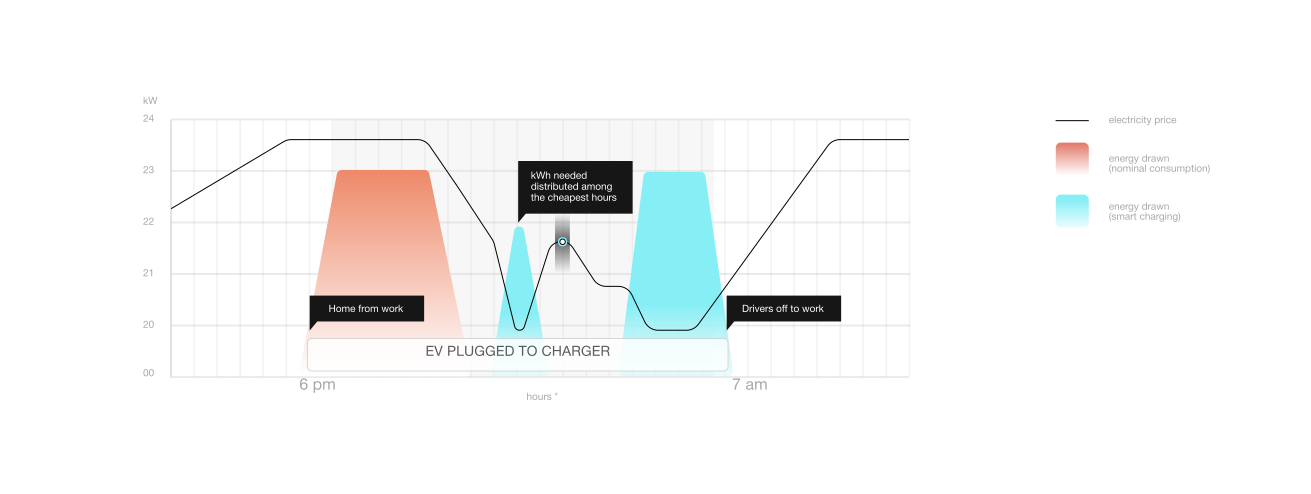
Let’s look at an example of a single EV. If electricity prices are flat, the only factors that determine the vehicle is charging are the habits and schedule of its owner. If they get home around 6:00 pm, guess when the EV will start charging? Just about 6:00 pm.

Now, imagine the energy company has introduced cost-reflective tariffs (e.g. time-of-use rates) or demand charges that penalize consumers exceeding certain kW thresholds. Suddenly the EV owner is subject to price signals, and stands to save on their electricity bill by shifting their charging schedule to when it’s cheap to do so and avoiding demand charges. This “behind-the-meter” optimization is a key feature of Emulate’s software.

As we broaden our perspective to the thousands of EVs and other energy-intensive smart devices in the world, smart consumption has enormous potential to ease the transition to renewable energy and reduce energy costs for consumers and businesses alike. Even better, it can do so without impacting comfort. The trick is to leverage the latent flexibility in our electricity usage. Delaying EV charging until the early hours of the morning is one approach, but several energy-intensive smart devices such as water heaters and HVAC systems can be similarly optimized.

Demand Response: Harnessing Flexibility

Demand Response can take advantage of this untapped flexibility as well. While these programs have typically relied on consumers manually adjusting their thermostat or turning off power-intensive devices, the proliferation of Wi Fi-enabled “smart” devices opens the door for software that can control these assets remotely and make Demand Response programs more effective and cost-efficient.

Current Implementation and Limitations

Stakeholders all along the electricity value chain have recognized the potential of Demand Response and adjusted their strategies accordingly:

  1. As mentioned above, electricity retailers are progressively exposing end-users to spot prices through different cost-reflective tariffs that incentivize consumption when energy is cheaper.
  2. Original equipment manufacturers (OEMs) and aggregators are building smart consumption features like smart charging and heating into devices so they can automatically optimize against spot prices.

While these developments have allowed consumers to reduce their electricity bills and accelerate the transition to renewables, they have issues of their own.

For end-users:

  • Multiple devices optimizing on the same signals can result in new demand spikes clustered around the cheapest prices, which can overload household fuses.
  • These consumption peaks can also result in additional costs if grid companies have introduced demand charges for exceeding a given demand threshold.
  • Individual devices tend to optimize against price signals alone, blind to other factors that could determine optimal behavior such as the consumption, generation, and latent flexibility from other devices in the same home system.

For energy companies:

  • Just as multiple devices within a single home might create a new demand peak, multiple households might do the same and cause a system-wide peak, causing headaches around distribution network congestion.
  • Smart consumption optimizes against electricity prices, which are themselves based on demand forecasts that are inherently uncertain. Shifting demand to a period when output is expected to be high (e.g. a bright, sunny afternoon) only for actual production to underperform can result in significantly higher real costs to the retailer.

A Holistic and Sustainable Approach

To address these challenges, we need a more comprehensive approach. One that:

  1. Considers multiple signals beyond spot prices. Account for grid tariffs that penalize high power peaks, balancing cheap energy with network load. Non-economic goals like self-sufficiency or minimized CO2 emissions should also be considered.
  2. Optimizes for the whole home. Devices exist as part of a holistic system, and optimization should treat them accordingly. Incorporate forecasts of each device’s consumption and flexibility, factor in current and predicted solar generation, and account for fuse limits. We analyze the benefits of this approach in greater detail below.
  3. Takes a system-wide approach. Smart consumption relies on spot prices to optimize usage. These prices attempt to reflect the real cost of energy, but are based on day-ahead forecasts that often prove inaccurate. We need a system that relies less on prediction, and more on reaction. Exposing flexibility to ancillary markets allows device-level consumption to react to system-wide signals that support overall grid stability.

Value Assessment

Emulate has developed a versatile framework to quantify flexibility and the benefits of whole-home optimization. It allows us to incorporate multiple assets – EVs, batteries, solar panels, and various types of HVAC units – and optimize for different objectives like minimizing energy cost, avoiding demand charges, and making a home self-sufficient.

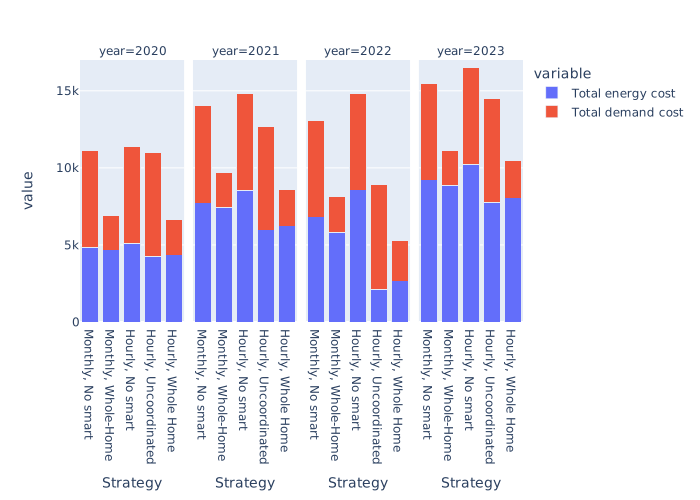
We simulated the electricity usage for a traditional mid-size house in southern Sweden based on different tariff models control strategies:

  • Tariff models for consumption
    • Hourly tariff, i.e. following spot prices
    • Monthly tariff, i.e. based on monthly average of spot prices
  • Control strategies
    • No smart control, i.e. constant indoor temperature and immediate charging
    • Uncoordinated optimization of each device against hourly tariff
    • Whole-home optimization that accounts for the cost of energy, demand charges, and income from solar power export

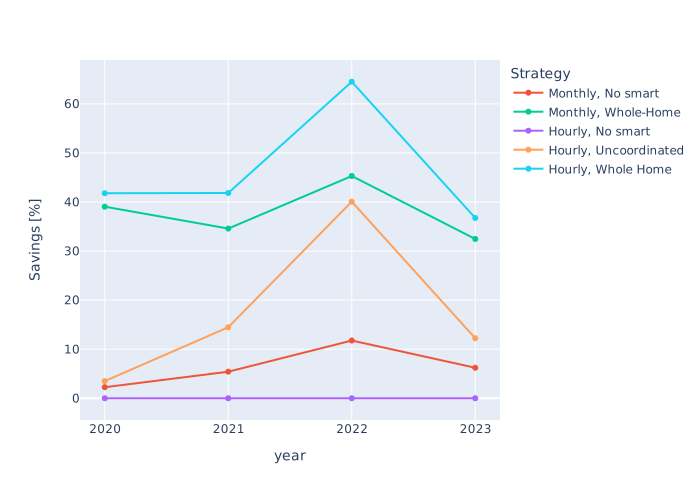
In all simulations, demand charges were applied and excess power from solar panels was sold at a tariff that follows the spot price. When drawing comparisons of savings to a baseline, our reference case is the one with an hourly tariff and without any smart control of appliances. All costs are expressed in SEK. The characteristics of the connected appliances is shown in the table below:

SourceMax Electrical Power [kW]Yearly Production / Consumption [kWh]
EV113,000
Heat pump (with electrical heater)2.5 (+4) 7,000
Base load22,800
Solar panels99,000

Our results demonstrate significant gains from smart, coordinated control of these devices:

  • With savings ranging from 36% to 65%, whole-home optimization outperforms the uncoordinated control of devices (3% to 40%)
  • When spot prices are highly volatile (2022), uncoordinated control manages to maximize the savings at about 40%, but it increases the demand charges compared with the reference case (no smart control and hourly tariff)
  • Whole-home optimization is able to minimize the cost of energy by arbitrage while minimizing demand charges. This in turn minimizes the risk of fuse overload and local grid congestion.
  • It is worth noting that the whole home optimization with monthly tariffs performs better than uncoordinated spot price optimization with hourly tariff. This is due to the efficient demand charge reduction and also some ability to schedule consumption to maximize profits from solar energy export.

While there are additional benefits of exposing this flexibility to electricity markets and supporting the broader energy system, this requires careful coordination since a device that is participating in the electricity markets cannot be simultaneously optimized for behind-the-meter use. The decision of how to best use any given device will depend on each household’s assets and behavior.

The benefits of a holistic, whole-home approach to optimization are significant and wide-ranging, and Emulate is leading the charge to unlock these benefits to energy companies and consumers today. We are always eager to connect with people excited about this technology, so please reach out to us at hello@emulate.energy!

Conclusion

Demand response represents a promising path forward for efficient and sustainable electricity consumption, but as renewable generation scales up and smart devices become increasingly popular, problems with the traditional approach have been laid bare. Emulate’s software mitigates these issues by accounting for signals beyond spot price, taking a whole-home approach, and seeing the home in the context of the broader electricity market. Every step toward refining and implementing Demand Response strategies brings us closer to a future where clean, affordable energy is accessible for everyone.

Unlocking the Concept of Virtual Batteries

In the age of renewable energy and smart technology, the traditional concept of a battery is being redefined. Enter the era of virtual batteries — a groundbreaking solution that leverages the collective power of flexible loads to stabilize the grid. This innovative approach is revolutionizing the way we manage energy consumption and mitigate the challenges of fluctuating supply and demand dynamics.

Flexible Loads: EVs and HVAC Systems

Key among these flexible loads are Electric Vehicle (EV) charging and Heating, Ventilation, and Air Conditioning (HVAC) systems. Unlike static loads such as lighting or appliances, EV charging, and HVAC consumption can be adjusted or scheduled to accommodate grid needs without compromising user comfort or convenience. This inherent flexibility makes them ideal candidates for inclusion in virtual battery schemes.

Electric Vehicle charging

Imagine a scenario where electric vehicles are not just a mode of transportation but also integral components of a dynamic energy ecosystem. Through smart charging algorithms and bi-directional communication between vehicles and the grid, EVs can act as distributed energy resources, actively responding to grid signals to either draw power or feed excess energy back into the system.

HVAC Systems

Similarly, HVAC systems, which typically contribute to peak demand during hot or cold weather, can be intelligently managed to smooth out load spikes. By adjusting temperature setpoints or implementing pre-cooling/pre-heating strategies during off-peak hours, HVAC units can reduce overall energy consumption while still meeting comfort requirements.

The beauty of virtual batteries lies in their scalability and adaptability. By aggregating thousands or even millions of individual loads, utilities and grid operators can create massive virtual batteries capable of providing significant grid services such as frequency regulation, load balancing, and voltage support. Moreover, the decentralized nature of virtual batteries enhances grid resilience by reducing reliance on centralized generation and transmission infrastructure.

Research Insights

In a study by the cofounder of Emulate EnergyDaria Madjidian, and his colleagues at MIT, titled “Emulating Batteries with Flexible Energy Demand, Fundamental Trade-offs, and Scheduling Policies”, the authors delve into the potential of utilizing the flexibility of flexible loads to emulate the functionality of a traditional battery. The paper investigates the fundamental properties of energy storage and explores the feasibility of aggregating flexible loads to mimic the behavior of a battery.

According to the findings of the study, a battery embodies three critical characteristics of energy storage: 

  • the capacity to store energy, 
  • the rate of energy absorption, 
  • and the rate of energy release. 

The authors derive upper bounds on the capacity achievable through the collective operation of flexible loads, highlighting a fundamental trade-off between the ability to absorb and release energy at high aggregate rates.

Conclusion

In conclusion, the emergence of virtual batteries marks a significant paradigm shift in how we conceive and manage energy systems. This innovative approach harnesses the flexibility of diverse electrical loads, such as Electric Vehicle (EV) charging and HVAC systems, to provide grid stabilization services traditionally associated with physical batteries. By leveraging smart algorithms and bidirectional communication, virtual batteries enable dynamic interaction between grid operators and distributed energy resources, unlocking new opportunities for grid optimization and resilience. After exploring the potential of electric vehicles and HVAC systems as a convenience load in a virtual battery, there is much more to explore about these transformative energy solutions. Stay tuned for our next blog post, where we delve into the latest developments in smart grid technology.

U.S. Market Expansion Alert!

We are thrilled to share that Emulate is expanding its presence in the U.S. market, taking us one step closer to our goal of enabling 100% renewable energy!

Our three first hires in the US will be driving our efforts:

  • Boston: Matthew Dillon, an Engineering M.Sc. from the University of Alaska Fairbanks, brings his extensive knowledge in software development and engineering to our team. Matthew’s passion for open-source initiatives and education further strengthens our commitment to making renewable energy accessible to all.
  • San Francisco: Geoffrey Broadwell, a UC Berkeley alumnus with a strong background in Computer Science, joins us with a wealth of experience gained from leading industry giants such as Google and thought leaders like Edument. With his expertise, we’re poised to continue launching industry-changing products!
  • Boston: Shwan Lamei, our visionary CEO and founder, boasts 15 years of experience in the energy and industrial sectors. Shwan’s leadership and expertise have been instrumental in driving Emulate’s success, and we’re excited to have him leading our efforts in the United States.

Join us as we embark on this journey to energize the future together!

Groundbreaking Collaboration: Emulate and Emabler’s Partnership in EV Frequency Regulation Services

In a world where collaboration is the bedrock of innovation, we are excited to share the formal partnership between Emulate and Emabler.  Comprehensive and successful tests have been conducted on Direct Current (DC) chargers with the ultimate aim to leverage our joint capabilities to unleash Electric Vehicle (EV) chargers’ potential for frequency regulation services.

Sonny Strömberg, COO of Emulate, sees the partnership as an opportunity to substantially contribute to the electricity system on a global scale. Strömberg emphasizes, “Our deep expertise in control and virtual battery technology, combined with Emabler’s innovative open platform for EV charging, is the perfect match. The cooperation will be beneficial for the consumers and the environment.”

Embracing the Energy Transition

As the world navigates the energy transition towards cleaner, sustainable power sources, the share of intermittent energy sources such as solar and wind power is rising exponentially. This shift, coupled with the surge in electrified devices, introduces a challenge: How do we offset the intermittency of renewable energy sources and maintain the balance between supply and demand while respecting consumers comfort expectations?

Taking on the Challenge of TSOs Ancillary Service Markets

The requirements to participate in Transmission System Operators (TSOs) ancillary service markets are stringent. Every participant must consistently deliver accurate and timely responses. This ensures that the stability and reliability of the grid are maintained, even as renewable energy sources fluctuate.

Delivering Promising Results​

Facing this challenge, the team-up between Emulate and Emabler shows real promise. Our joint tests aimed to demonstrate our systems’ capability to meet these stringent standards, and the results have been very positive.

eMabler CEO Juha Stenberg chimes in, “Through a comprehensive live test, we’ve proven that technology is now ready to play a vital role in the energy market. This applies both to keeping the energy network balanced and making good business sense. For those who own and operate charging stations, there’s a fresh perspective on the potential of EV charging. By combining energy sales with income from the energy market, a new avenue of revenue opens up. This advancement also becomes a significant asset in our ongoing efforts towards a more sustainable future.”

Emulate and Emabler conducted the tests on Skellefteå Kraft and OKQ8 chargers whose joint venture leads the market in public, fast EV charging across Sweden and Denmark. Scheduled for rollout between 2021 and 2026, the project features cutting-edge 150 kW chargers, exclusively powered by renewable energy.

Marching Towards a Sustainable Future​

Emulate and Emabler’s partnership marks an important step in exploring the potential of EV chargers for frequency regulation. As the world continues to embrace the energy transition, such collaborations can serve as catalysts in addressing the challenges that come with the increasing share of renewable energy. By utilizing electrified devices to offset intermittency, we are ensuring a more resilient, sustainable, and balanced energy future.

Emulate’s unique Virtual battery technology based on cutting-edge research at MIT coupled with Emabler’s open software approach is a powerful combination. Stay tuned for more updates as we continue to forge ahead in our mission!

Axel Johnson AxSol, Skellefteå Kraft, and Utvecklingsklustret invest in Emulate Energy

AUG 15, 2022LUND- AND BOSTON-BASED STARTUP EMULATE ENERGY RAISE 22 MSEK

An obstacle to 100% renewable energy is the ability to store energy on a mass scale. Emulate has developed an algorithm that emulates a physical battery by utilizing changes in electricity demand. Instead of relying on raw materials to build physical batteries, Emulate’s virtual battery tackles energy storage challenges by deploying cutting-edge research to build smart digital solutions. The core technology is a spin-off from academic research conducted at MIT.

– With the backing of some of the world’s most progressive energy companies, Edument’s software expertise, and a player such as Axsol, we are in a great position to solve one of the biggest societal challenges we have ahead of us. This is a very important step and milestone for our company. Next is to add top talent to our growing team and scale our business internationally, says Shwan Lamei, CEO and founder of Emulate.

Emulate’s software creates new business models for electricity retailers and empowers end users to become an active part of the energy transition. The software balances renewable energy production with demand and paves the way for the electrification of transportation and heat.

The purpose of Emulate Energy is to make renewable energy 100% accessible to the entire world. To do this the company has addressed the challenge of energy storage. Emulate was founded in 2020 with the mission to accelerate the global transition to clean energy. Emulate is headquartered in Scandinavia, a global center for energy transition and companies focused on solving energy challenges